News Update: Australia Renews Circular Packaging Strategy
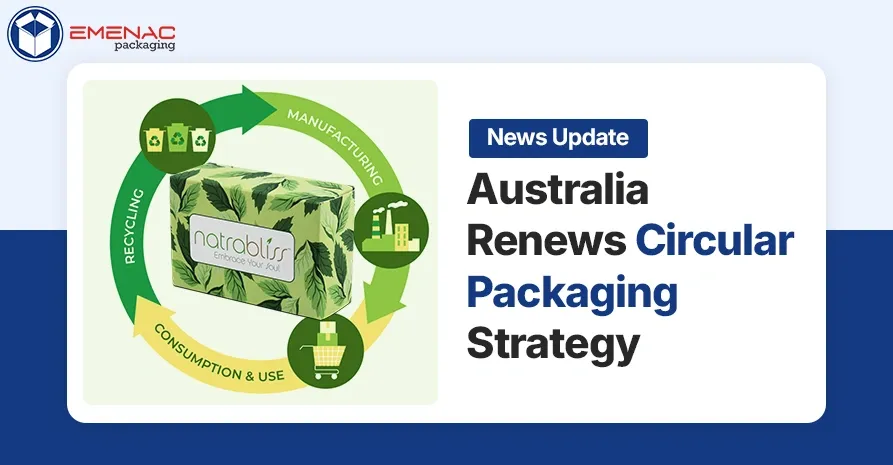
Australia has taken a big step moving towards a circular economy by updating its national strategy regarding packaging. The details that have been out and the focus of the amendment are mostly on reducing the usage of single-use plastics, encouraging packaging companies to rewire their design and manage their supply chain while increasing the overall recycling rates. This move is evidence that governments and businesses are now open to debating environmental impact and changing their routes to reduce the overall packaging waste.
In this blog, we are going to highlight the new national strategy for Australian circular packaging, its key features, its targets, and the issues that need to be resolved. If you are a brand owner, then you must know the new packaging terms and conditions to stay updated. Scroll down for in-depth information!
A New Outlook for Packaging Policy
Australia’s Department of Climate Change, Energy, the Environment, and Water recently announced this update. The government has shown strong will & commitment to strengthen its circular packaging practices and also to further support the packaging industry. The main objective behind the drive is to improve recycling systems and reduce waste to a great extent.
This scheme is part of the country’s national packaging targets, aimed to renew the entire packaging sector by motivating others to reuse and recycle packaging material. Additionally, to redesign the management of the packaging industry and the supply chain system.
Key Targets
Although Australia Packaging Industry Renewal has several targets, we are going to share the core goals for a clearer perspective.
- A total of 100 % of the packaging material has to be either recyclable, reusable, or compostable.
- 70% of the plastic packaging material needs to be composted or recycled.
- Overall, an average of 50% recycled content must be used across packaging.
- Companies need to halt the use of single-use plastics in phases and avoid and replace the unnecessary use of plastics for a single time.
These key targets are recommended to revive the process of packaging design, its production, and recovery. Businesses are now expected to incorporate environmentally friendly principles into the product design and supply chain management.
Issues to be Resolved
Industry data highlights that the key targets of the reform have not yet been achieved. Although the transformation is finding its way, the ride has still not been so smooth. Plastic recycling rates still remain quite lower than the expected levels, whereas the utilization of recycled materials has not even met the forecasted average.
Experts have suggested that since the packaging system is quite intricate, it might require cooperation across multiple sectors. Starting from the point of waste collection towards the recycling infrastructure, all the way towards product design, each factor decides whether the packaging material will benefit the economy or not.
The second most confronted challenge is the regulatory framework. Various Australian states have enacted their own rules to restrict the use of single-use plastics, which creates challenges and a lack of uniformity for companies operating nationwide.
An Emerging International Trend
Australia’s new laws are not limited only to its land; in fact, they reflect a profound transformation taking place globally. Governments, internationally, are initiating strict rules to reduce packaging waste and have requested manufacturers to take on responsibility for the lifecycle of their products and packaging.
The latest strategy is a new beginning and one step ahead for Australia, transitioning from waste management towards a full circular system. The success of this drive still depends on how the policymakers, packaging industry, and consumers can work together and retain materials for a longer time.
Fundamental Requirements
Businesses with an annual turnover of AUD 5 million are now required to comply with national packaging laws under the Packaging Regulation Australian Framework. Following are the significant policy takeaways:
- Companies now have to be a part of the Australian Packaging Covenant Organisation (APCO), which is the main industry’s stewardship body.
- The associated companies must report their packaging data directly to a territory or a state regulator.
- If the companies do not correspond to the above points, then they must participate in an alternative scheme that might deliver equivalent results and fulfill all the dedicated requirements.
Wrap Up
The Australian government has revived its packaging strategy to limit the use of plastics and to encourage recycling and reuse habits among businesses and consumers. The businesses can integrate the new regulations in phases to fully comply with the new circular packaging laws introduced by the government.
Here at Emenac Packaging Australia, we are also complying with all the notified regulations to promote a sustainable environment. We have an amazing variety of custom boxes available on our website. Check out our Kraft boxes with lids here!
Thank you for reading our blog!
Share This