
The Role of Nanotechnology in Modern Food Packaging
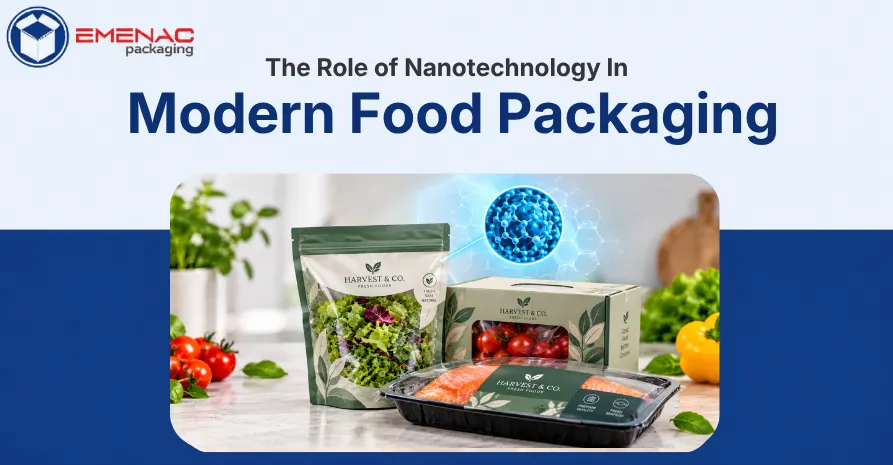
Packaging is vital for distributing and storing the food. The central function of the packaging material is to preserve food quality and keep it fresh and sealed in. Packaging is usually made out of different materials such as glass, metal, and paper, or even combined materials for more sturdy protection.
In today’s times, a mechanical barrier is added to provide extra moisture and easier storage. Adding the all-new engineered nanotechnology into modern food packaging can help in developing novel yet smart packaging solutions.
In this blog, we are going to discuss how adding this technology to your brand’s packaging secures your food products even more. Additionally, we will also discuss its future outlook along with the key challenges currently being faced. So let’s begin!
Four Aspects Of Nanotechnology In Modern Food Packaging
Nanotechnology focuses on four different attributes in food packaging:
- Enhanced packaging stability
- Better barrier functionality by cutting off gas exchange
- Containing antimicrobial properties
- Helps to develop smart packaging that attracts customers.
The EU currently allows engineered nanomaterials in food packaging, such as zinc oxide, titanium oxide, carbon black, and silica. Whereas, on the other hand, according to EU regulations, some food packaging materials are termed under the category of “nanoparticles,” i.e., substances with particles in the nm range, such as silica and carbon black.
Did you know that the size of the global market for nanotechnology packaging was estimated at around USD 34.52 billion in the year 2025? Additionally, it is forecasted to reach from USD 39.84 billion in 2026 to around USD 139.71 billion by 2034.
The Functions Of Nanotechnology
1. Enhanced Packaging Stability
Various materials, such as titanium oxide and titanium nitride particles. Silica nanoparticles and chitosan are added into the polymer matrix to enhance the plastic packaging material or to be used as an upper coating.
These materials provide an overall stability by delivering mechanical strength and material stiffness. Moreover, the nano-particles of titanium oxide and silica are best known to further supply hydrophobic properties to paper-based packaging material.
2. Better Barrier Functionality
The problem of degassing in beverages is huge, and it can be easily prevented by incorporating nanoparticles of silicon dioxide into the polymer matrix. This simple trick limits the diffusion of vaporized gas or water through the packaging material.
Furthermore, adding titanium dioxide nanoparticles is useful to lock in the freshness and extend the shelf life of vegetables as well as fruits, as they deactivate ethylene or oxygen through the use of the UV-induced photocatalytic effect of these nanoparticles.
3. Environmental Benefits Of Nanotechnology
Nanotechnology is also known for supporting sustainability and eco-friendliness in packaging material by facilitating biodegradable nanocomposites and overall reducing the material usage. Their discovery has not only improved recyclability but has also helped lower the volume of plastic waste, while preserving optimal quality.
Researchers globally are focusing more on finding more eco-friendly nano-materials for encouraging green initiatives.
Migration Of Nano-Particles Into Food
The potential risk of the migration of nanoparticles into food packaging is an open risk for consumers. Let’s talk initially regarding nano-silver, as there is a small possibility that it might get transferred into liquid from PET bottles.
Some studies show the release of such particles, while others show null results, as the debate around it still continues. The studies that have found the particles migrating over time indicate that titanium nitride and nanoclays have a strong tendency to get transferred.
The five approved nanomaterials by the European Food Safety Authority (EFSA) for food-grade use are selenium nanoparticles, zinc oxide, silica, and titanium nitride. But as per recent research, the fifth compound, namely montmorillonite clay, which consists of alumina and silica, a mass transfer of nanoparticles below or at the limit has been detected, which makes it debatable.
According to an exploratory study done by Sharma et al. (2017), nanotechnology is an innovative emerging tool in the food-packaging industry that is contributing towards improving the quality, shelf life, and food safety of the products.
Further, the research also highlights that integrating nanomaterials such as metallic nanoparticles, carbon nanotubes, nanoclays, and biopolymer-based nanostructures into packaging films can overall enhance the barrier properties, such as moisture, oxygen, and microbial contamination, which helps in extending the preservation time and decreases the ratio of food spoilage.
Future Outlook
Although nanotechnology has a lot of advantages, safety concerns regarding the transfer of nanoparticles in food can still pose health risks. Scientists are still working on regulatory frameworks in order to ensure the secure use of nanomaterials in packaging.
Another report suggests that nanotechnology is going to play a significant role in developing safer, smarter, and more eco-friendly packaging systems in the future.
Wrap Up
The scope of the study of the role of nanotechnology in modern food packaging has increased over the past few years. Similarly, nanomaterial-based devices play a significant role in the food industry, including both the preservation of food and the packaging process.
Nanomaterials are proven to be resourceful in increasing the shelf life of food by protecting it from gases, lipids, and moisture. As a brand owner, if you are thinking of incorporating this technology for packaging your products, then it can be a great addition.
Here at Emenac Packaging Australia, we believe in trying out new techniques to make our boxes more appealing and sustainable as well as sturdy. Check out our great collection on our website.
Thank you for exploring our blog with us!
Share This


